

Why I think the 19th-century periodical still has something to teach us about ideas, influence, and the cost of intellectual courage
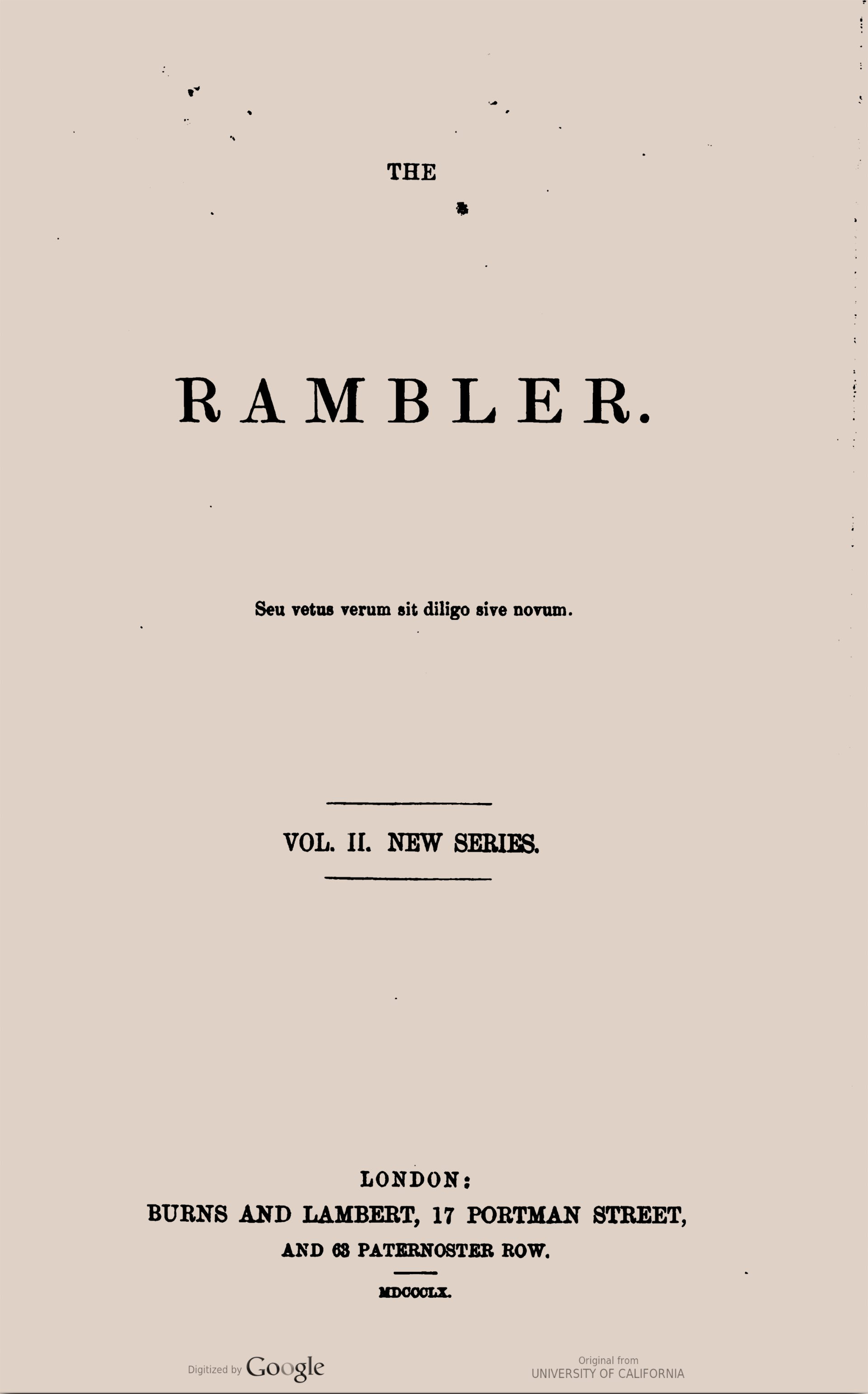
A few years ago, I drove to the home of two retired Catholic scholars, James and Mary Holland, to pick up a book donation for the Acton Institute, where I work as librarian. We spent the afternoon packing shelves of British history—many volumes featuring Lord Acton’s closest allies and fiercest adversaries, including a few figures who could claim to have been both.
Then Mary reminded James not to forget the basement.
In the basement was a complete bound set of The Rambler—the Catholic magazine so intimately associated with Lord Acton—annotated in the Hollands’ own hand. Anonymous Victorian bylines, so often absent in periodicals of the era, had been carefully penciled into the margins. I loaded The Rambler last, and I loaded it best. It rode in the passenger seat, shotgun, all the way back to Grand Rapids.
That night at the hotel, I couldn’t sleep. I went out to the truck, retrieved the box, and leafed through a volume. It didn’t feel right to leave them out in the cold.
---
From a 21st-century vantage point, this might seem eccentric. Why would a librarian give pride of place to a *magazine* over so many significant and rare books?
The answer is bound up in a question I explore in an old essay for Religion & Liberty: **Was there a time when a mere magazine could shake up institutions and sway generations?** And if so, have we sacrificed that kind of scholarship for persiflage and influence for “likes”?
Lord Acton thought magazines were the most powerful intellectual medium of his age. The best writers and statesmen of the world, who formerly would have written a book or a pamphlet, were instead contributing articles to leading reviews and magazines that would be read across Europe before the month was out.
So Acton took the editor’s chair at *The Rambler* in 1859. His mission was ambitious: to unite a hearty acceptance of Catholic dogma with free inquiry and discussion on every question the Church left open to debate. He wanted to give voice to a newly emancipated English Catholicism—the first generation since the Reformation to live their adult lives with full rights as citizens and ordinary church governance as Catholics.
The resistance he met was extraordinary. One contributor, Richard Simpson, was denied absolution after confession because of his work for the magazine. When John Henry Newman briefly assumed editorship to appease critics, his own article was reported to Rome. Ecclesiastical censure was a constant shadow.
Acton was eventually pushed into a corner. Rather than submit to a clerical board of censors or water down the magazine’s commitment to truth, he shut it down—and then immediately launched a successor, Home and Foreign Review, which inherited all the old enemies. Its very first issue insisted on referring to Pope Paul III’s “son” rather than the polite euphemism of “nephew.” It lasted two years.
His closing editorial remains one of the great statements on intellectual conscience. He would not abandon principles sincerely held. He would not attack legitimate authority. He chose both obedience and freedom by sacrificing the magazine itself.
---
In the essay, I trace what I call “the Rambler effect” forward into 20th-century America. Magazines like Christian Century, Commonweal, and Christianity Today didn’t just reflect the mainline, Catholic, and evangelical communities—they helped constitute them. Fr. Richard John Neuhaus attempted a brilliant ecumenical synthesis with First Things in 1990, coordinating writers from across traditions until, inevitably, the tensions boiled over too.
Each of these magazines placed a bet that the periodical format—regular, curated, edited with a coherent vision—could shape the intellectual life of entire communities. And each of them, to varying degrees, won that bet.
So what about now? Information and influence today ride on algorithmic tides with no moon’s constancy. Link rot steadily erases the digital record. The editorial vision at most outlets has narrowed even as the platforms have multiplied.
I think there’s still a case for the magazine—for writing packaged in regular intervals, shaped by editorial judgment, and ambitious enough to reach beyond our sects and partisan identities. Lord Acton’s moral vision has never been more resonant. The ideological evils he identified—radical egalitarianism, socialism, nationalism—cannot be confronted by those of little faith or none at all.
The morning after I picked up The Rambler, I woke up to revision notes from my own editor on a magazine article I’d sent before leaving Grand Rapids. I made my edits, closed the laptop, and looked across the room at the box containing the bound volumes.
“There’s articles left in you yet.”
---
**Read the full essay in Religion & Liberty*, Volume 34, Number 2:**