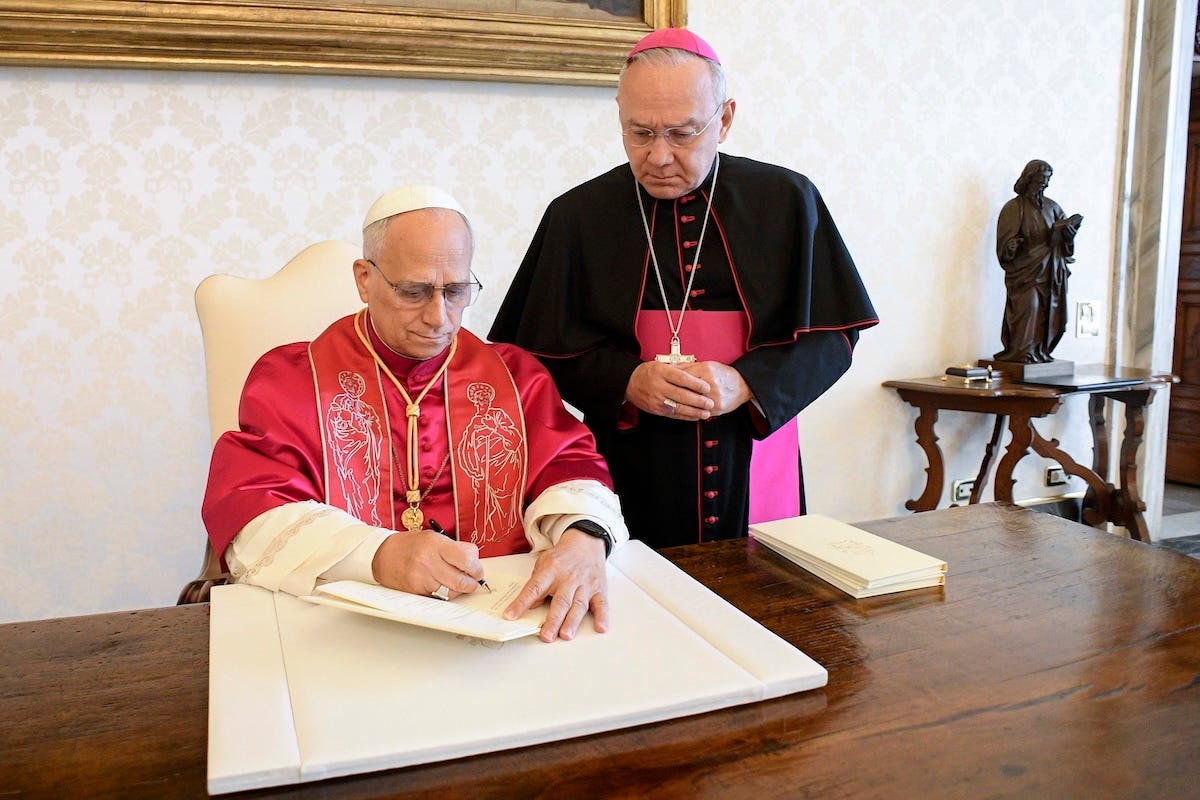
In his first official address to the College of Cardinals on May 10, 2025, Pope Leo XIV signaled what he understood to be among the defining tasks of his papacy: “In our own day, the Church offers to everyone the treasury of her social teaching in response to another industrial revolution and to developments in the field of artificial intelligence that pose new challenges for the defence of human dignity, justice and labour.”
The choice of name was telling. It was Pope Leo XIII who, in 1891, addressed himself to the “new things” (rerum novarum) of the modern industrial economy, employing the Church’s perennial moral wisdom to engage the still-young categories of “land,” “labor,” and “capital.” With his choice of name and the words of his first address, Pope Leo XIV has placed artificial intelligence within a long arc of Catholic engagement with technological and economic change. A new encyclical is on the horizon.
It seemed a fitting moment, then, for the Acton Institute to take up these questions itself. I recently had the privilege of moderating a three-part video series, On The New Things, in which I sat down with three colleagues to consider what AI is doing, and might yet do, to our economic, historical, and anthropological self-understanding.
AI & Economics — with Dr. Stephen Barrows
The economist’s first instinct, when confronted with a new technology, is to ask what it does to prices, productivity, and the structure of work. Stephen Barrows and I take up exactly these questions. We discuss the short-term dislocations AI is likely to inflict on particular kinds of labor and the long-term potential for AI-driven productivity gains to underwrite robust global economic growth, lower the cost of living, and expand human possibility.
The honest answer is that both stories are likely to be true. The technological revolutions of the past have generally vindicated neither the Luddite nor the utopian, however well each is represented in our cultural imagination. They have, instead, demanded patience, prudence, and serious thought about what work is for in the first place.
Watch: On The New Things | AI & Economics with Dr. Stephen Barrows
AI & History — with Dr. John Pinheiro
If economics asks what is happening, history asks what has happened before. John Pinheiro joins me to situate our present moment within the longer story of modern technological change. We return to the original Industrial Revolution—its real human costs, its real human benefits, and the Church’s response in Rerum Novarum—to consider what it might mean to navigate AI without succumbing either to a reflexive Luddism or to a credulous utopianism.
The history is more interesting, and more useful, than either of those received postures. It is also more demanding. To take the past seriously is to recognize that we have been here before, in our own way, and that the resources of the tradition are not exhausted.
Watch: On The New Things | AI & History with Dr. John Pinheiro
AI & Humanity — with Michael Matheson Miller
Beneath every question of regulation, capability, and labor market dynamics lies a deeper one: what is the human person? Michael Matheson Miller and I take up the anthropological questions directly. Is artificial intelligence in fact intelligent? What is it that we are doing when we converse with a large language model, or trust an algorithm to mediate our relationships, our judgments, our attention? What becomes of human freedom, vocation, and the interior life when we are increasingly accompanied by systems designed to anticipate, predict, and shape us?
These are not entirely new questions. They were Philip K. Dick’s questions, and in their deepest form they were St. Augustine’s. But they are newly urgent.
Watch: On The New Things | AI & Humanity with Michael Matheson Miller
Whether your concerns about AI center on the labor market, the proliferation of deepfakes, or the slow erosion of authentic human encounter, this series offers a framework rooted in human dignity and the long tradition of Catholic social teaching to help orient us toward the questions that matter most.
As Pope Leo XIV has reminded us, we are not the first generation to face new things, and we will not be the last. The task is to bring to bear the resources of faith and reason on the moment in which we find ourselves—and to do so without fear.