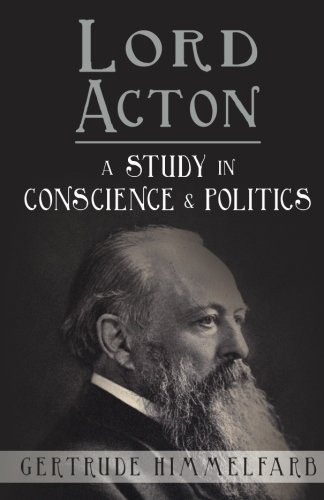
I first picked up Gertrude Himmelfarb’s Lord Acton: A Study in Conscience and Politics years before I ever imagined I would one day help bring it back into print. It was the book that introduced me to Lord Acton, not the Acton of the famous aphorism about power and corruption, but the full, complicated, brilliant man behind it. And it permanently changed the way I think about history, conscience, and the relationship between faith and freedom.
Everyone knows the line. “Power tends to corrupt, and absolute power corrupts absolutely.” It may be the most quoted sentence in the history of political thought. But Acton’s life and writings go immeasurably deeper than any single maxim, and it was Himmelfarb who first made that depth accessible to a modern audience.
A Biographer Equal to Her Subject
Himmelfarb began her study of Acton as a doctoral dissertation at the University of Chicago in the late 1940s, publishing it as her first book in 1952. The timing matters. She was writing in the immediate aftermath of World War II, with the horrors of Nazism and the emerging threat of Soviet totalitarianism fresh in the world’s memory. In that context, she recognized something that Acton’s own contemporaries had largely missed: his moral realism was not the eccentricity of a Victorian aristocrat but a prophetic warning to the modern world.
As she put it with characteristic precision, Acton “is of this age more than of his.” The naive optimism and crude materialism that dominated so much of the nineteenth century had been shattered. And there stood Acton, vindicated, a thinker who had never been taken in by the comfortable illusions of progress, and who could therefore speak with authority when history ran amok.
Too Liberal for the Catholics, Too Catholic for the Liberals
What makes Himmelfarb’s biography so enduring is her refusal to reduce Acton to a tidy ideological category. He was, as she memorably described him, “too Liberal for the Catholics and too Catholic for the Liberals.” A devout Catholic who waged a fierce campaign against papal infallibility at the First Vatican Council. A passionate champion of political liberty who insisted that freedom without moral foundations was no freedom at all. A prolific essayist and editor who envisioned a magisterial history of liberty but never wrote a single book.
These paradoxes would tempt a lesser biographer into oversimplification. Himmelfarb resisted. By hewing carefully to Acton’s own written work (his essays, lectures, reviews, and voluminous correspondence) she produced a portrait that balances criticism with genuine sympathy toward a complicated and often anguished mind.
Her central insight was that Acton’s commitment to liberty was inseparable from his Catholic faith. The liberals of his day wanted political freedom at the expense of the Church, and traditional Catholics wanted the Church at the expense of political freedom. Acton understood what neither camp could see: that in a pluralistic society, the Church’s freedom could only be guaranteed by a genuinely free political order, and that a free political order required the moral grounding that religion provided. Liberty and conscience were not rivals. They were partners.
A Life Worthy of the Subject
Himmelfarb herself was a remarkable figure. Born in 1922 to Russian Jewish immigrants in a one-bedroom apartment in Bensonhurst, Brooklyn, she rose to become one of the foremost historians of Victorian intellectual life. At Brooklyn College she amassed enough credits to have majored in history, economics, and philosophy simultaneously, while commuting at night to the Jewish Theological Seminary for a parallel degree. At a Trotskyite gathering, she met a young man named Irving Kristol. They would be married for sixty-seven years.
Her body of work after the Acton biography was extraordinary: Landmark studies of Charles Darwin, John Stuart Mill, and George Eliot, alongside sweeping social histories of Victorian Britain that explored how an entire culture wrestled with questions of poverty, compassion, and moral responsibility. She brought a Victorian sensibility to contemporary American debates, insisting that questions of virtue and character were not quaint relics but urgent necessities.
When she passed in December 2019 at the age of ninety-seven, it was the end of a truly singular career. She was, as I wrote at the time, “one of those rare thinkers and writers who were the total package: prolific, scholarly, and a virtuoso of the writing craft itself.”
Bringing the Book Back
When Lord Acton: A Study in Conscience and Politics went out of print, I had the privilege of working to bring it back in a new typesetting from the Acton Institute. It was my first major book project, my introduction to the intricacies of editing and publishing, and an honor I still feel keenly. The book remains, in my view, unmatched as a concise, lively, and insightful account of Lord Acton’s life and thought. It is simultaneously the best introduction to Acton and the key to understanding Himmelfarb’s entire intellectual project.
When I was preparing my own first edited volume, Lord Acton: Historical and Moral Essays, Himmelfarb was the first person I thought of for an endorsement. Her biography had been an inspiration for the project from the beginning. She graciously offered words that I keep by my desk to this day: “A new volume of essays by Lord Acton is more welcome than ever. In the present state of cultural and social disarray, his reflections on history and modernity are as perceptive and prescient today as they were over a century ago.”
Why This Book, Why Now
We live in a moment that would have been grimly familiar to Acton. Ideological certainties harden into dogmas. Political power is treated as an end in itself rather than a trust to be exercised with restraint. Moral questions are dismissed as distractions from the real business of politics, or worse, weaponized for partisan advantage. The relationship between faith and public life remains as fraught as it was in Acton’s battles with Rome.
Acton saw all of this coming. Himmelfarb saw that he had seen it. And she gave us a book that makes his vision available to anyone willing to sit with a difficult, demanding, and ultimately hopeful thinker.
For those interested in exploring Himmelfarb’s life and legacy further, I highly recommend Nicole Penn’s excellent essay “The Historian’s Craft” in National Affairs, as well as our conversation about it on the Acton Line podcast. Penn explores how Himmelfarb’s encounter with Acton shaped her entire career, her conviction that history is a craft demanding both rigor and moral imagination, and her belief that the historian’s vocation carries with it a responsibility not merely to record the past but to illuminate the present.
Pick up Lord Acton: A Study in Conscience and Politics. It is the best book on one of history’s greatest defenders of liberty and conscience, written by one of the twentieth century’s finest historians. In the present state of things, we need both of them more than ever.