

Lord Acton, spent most of his life on a book he never finished. It would have been called “The History of Liberty,” and his friends joked that it was the greatest book never written. What Acton did leave behind, scattered across lectures and articles in Victorian magazines, was a conviction he held with the force of a creed: liberty is “the delicate fruit of a mature civilization.” It is not a default condition of human affairs. It is not bequeathed by good intentions or by good documents. It is grown.
Where it has taken root (with fascinating exceptions) the soil has been Christian.
This is an unfashionable claim in 2026, and what makes it unfashionable is instructive. Two camps with little else in common share a strong interest in severing American liberty from its Christian inheritance. Secular progressives wish to do so in order to liberate the American project from what they regard as parochial constraint. postliberal Catholics and Christian nationalists wish to do so in order to expose the American project as a Lockean Trojan horse smuggling Enlightenment subjectivism into Christendom. The conclusions diverge wildly. The premise is the same: that the American founding can be cleanly cut from the long Christian reflection on conscience, law, and the limits of political authority that preceded it.
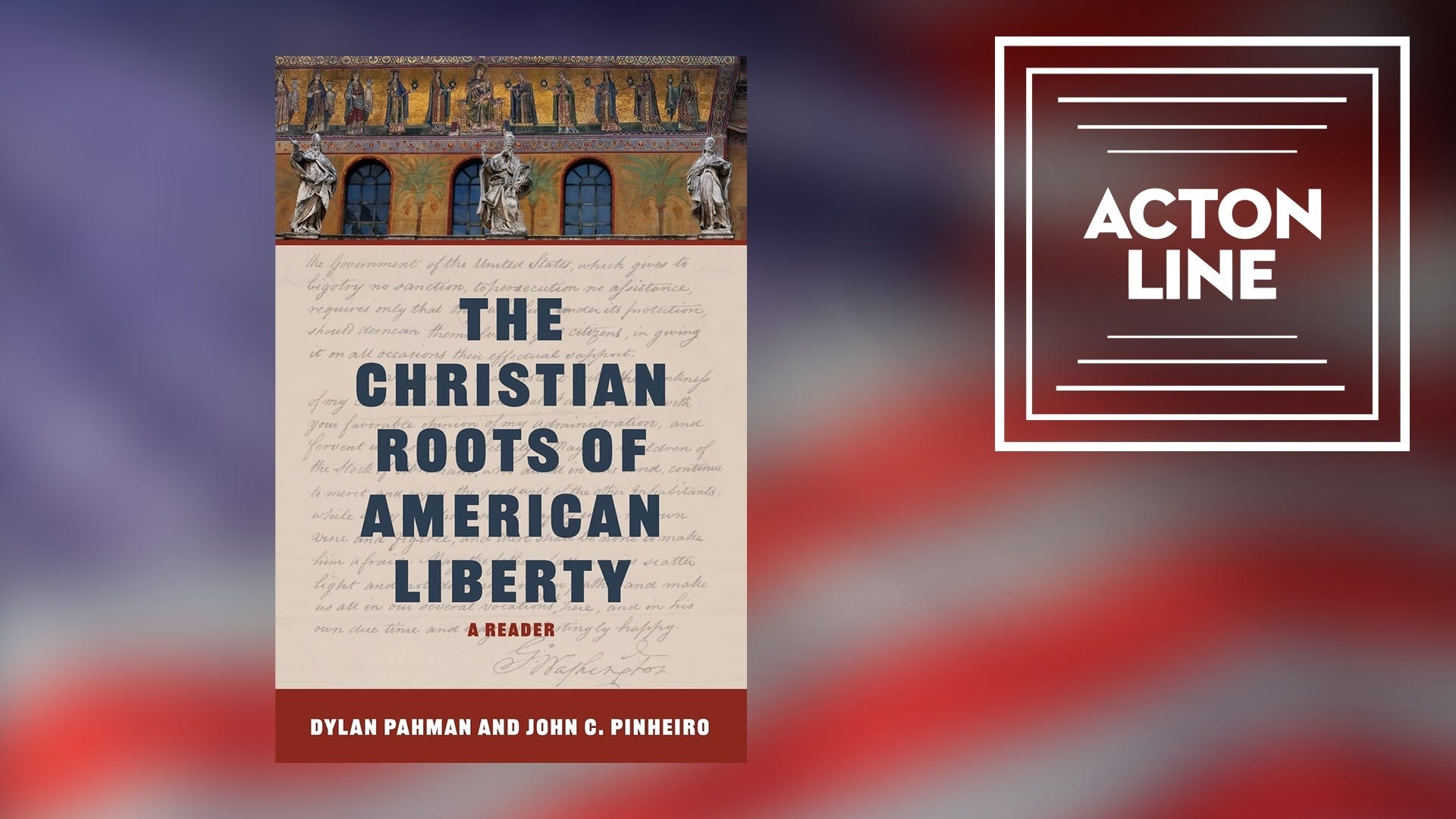
It cannot. And on the latest episode of Acton Line, my colleagues Dylan Pahman and John C. Pinheiro patiently explain why.
Their project, documenting the Christian roots of American liberty, is not an exercise in apologetics. It is an exercise in historical recovery. The two distinguish themselves admirably from the loudest voices in this debate by refusing the temptation either to claim too much or to concede too much. They do not argue that America was a baptized polity, nor do they argue that it was a secular accident with religious frosting applied after the fact. They argue, with documents in hand, that the moral and intellectual habits that made ordered liberty thinkable in 1776 were habits cultivated over centuries of Christian engagement with classical sources, canon law, scholastic philosophy, Reformation doctrines of conscience, and the long argument over what the things that are Caesar’s and the things that are God’s.
Acton put the matter unforgettably. “When Christ said: ‘Render unto Caesar the things that are Caesar’s, and unto God the things that are God’s,’ those words, spoken on his last visit to the Temple, three days before his death, gave to the civil power, under the protection of conscience, a sacredness it had never enjoyed, and bounds it had never acknowledged.” That is not a sectarian observation. It is a historical one. The bounding of political authority by something higher than itself is the precondition of any liberty worth the name, and the bounding of political authority by something higher than itself was, in the West, the work of the Church.
Pahman, an Orthodox theologian, and Pinheiro, a Catholic historian, bring complementary gifts to this work. Pinheiro’s earlier writing on Pope Leo XIII showed how the careful distinction between true and false liberalism allowed the Church to defend human freedom without surrendering to rationalism, atomism, or contempt for tradition. The same disposition animates this conversation. There is a liberalism that is, in Wilhelm Röpke’s phrase, “specifically Catholic” in its social philosophy: organic, deferential to mediating institutions, and alert to the dignity of persons. There is also a liberalism that is none of those things. To collapse the distinction is to lose both the criticism worth making and the inheritance worth defending.
Pahman, for his part, has done sustained work on what Christian social thought actually requires of a free economy and a free polity. His instincts run away from abstraction and toward concrete description. The Christian roots of American liberty are not a slogan for him but a continuing tradition recorded in texts, councils, magistrates, dissenters, charters, and arguments that can be named and footnoted. The recovery he and Pinheiro are undertaking is therefore not vulnerable to the standard objection that this is all sentimental civic religion. It is documentary work.
This kind of project matters now, beyond the partisans of either side of our current debates.
A republic that does not know what produced it cannot defend what it has. The American settlement is, as Acton suspected of all settlements, imperfect. But it is also the most durable working approximation of ordered liberty that has yet been achieved at scale, and it was not produced by a generation of pure rationalists or a generation of pure theocrats. It was produced by men and women who had inherited a long argument and were prepared to continue it. That argument predates John Locke by a millennium. It includes Augustine on the two cities, Aquinas on natural law, the late Scholastics at Salamanca on the just price and the rights of conscience, the English common law tradition with its theological underwriting, and the Reformation insistence that the conscience cannot finally be coerced. Cut any of these strands and the rope frays.
This is also why the project is unlikely to satisfy either of the camps I mentioned at the outset. The secular progressive will find too much Christianity in it. The integralist will find too much liberty in it. So much the better. The honest reader, of whatever conviction, will find what Pahman and Pinheiro are after: a serious attempt to describe the actual genealogy of American liberty rather than a tendentious attempt to claim it or denounce it.
There is a final reason to listen to this episode of Acton Line. The work of recovery is itself a kind of apprenticeship in the virtues that produced what is being recovered. To sit with sources, to make distinctions, to refuse easy synthesis, to hold authority and free inquiry together rather than playing one against the other—these are habits of mind, and they were cultivated, before they were ours, in cloisters and cathedral schools and dissenting congregations. We do not have to share the faith of those who cultivated them to recognize the debt, but we should not pretend the debt does not exist.
Acton’s unwritten history of liberty would, I suspect, have made just this point. Pahman and Pinheiro are doing some of the work he left undone.
Listen to the full conversation on Acton Line:
🎥 YouTube 🎧 Acton.org show notes and audio
Excellent. Thanks, Dan.