Last week, Meta announced that Horizon Worlds, the flagship social platform of Mark Zuckerberg’s metaverse vision, will be pulled from VR headsets at the end of March and shut down entirely on June 15. After more than $80 billion in investment, the product that was supposed to be “the next frontier” never managed to attract more than a few hundred thousand users a month. Zuckerberg predicted a billion. Reality Labs, the division responsible for the metaverse, posted a $6 billion operating loss in the fourth quarter of 2025 alone, and Meta has already cut over a thousand employees from the unit this year. The company is now pivoting, as they say, to artificial intelligence.
I am not surprised.
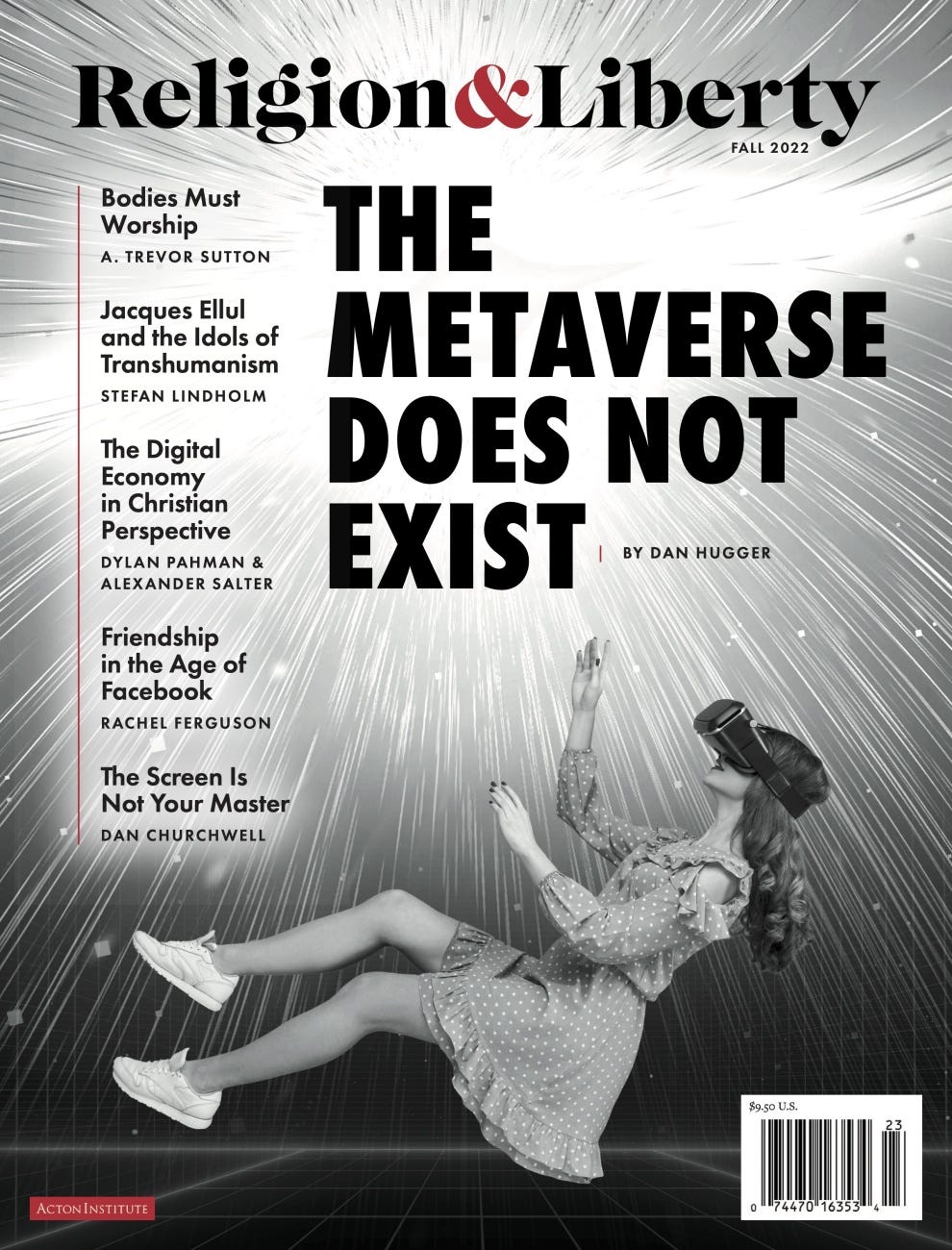
In the fall of 2022, I wrote an essay for Acton’s Religion & Liberty called “The Metaverse Does Not Exist.” The title was meant literally. The metaverse did not exist. It was a fiction built upon science fiction. The term was coined by Neal Stephenson in his 1992 novel Snow Crash, its predecessor “cyberspace” by William Gibson a decade earlier. What interested me was not the technology itself, which was obviously underwhelming, but the desire behind it. What did the dreamers of Silicon Valley actually want? What were they promising? And what might the science fiction writers from whom they borrowed their vocabulary tell us about the nature of those promises?
The essay traced the metaverse concept through the works of Philip K. Dick, who spent his entire career asking two questions: What is reality? and What constitutes the authentic human being? Dick understood, in a way our technological visionaries never quite did, the peril of manufactured realities. He was himself a man of tenuous grip on the real—plagued by mental illness, substance abuse, and highly idiosyncratic mystical experiences—but that made his warnings more credible, not less. He knew what it meant to be a victim of one’s own fictions.
Dick’s 1965 novel The Three Stigmata of Palmer Eldritch offered what I still think is the most vivid literary anticipation of the metaverse. Colonists on hostile alien worlds escape their miserable existence through a shared hallucinogenic experience, miniature doll-house layouts animated by a drug called Can-D, that begins as escapism, becomes a religion, and leaves the real world in ruins. The only colonists who resist are the Neo-Christians, who recognize the idolatry for what it is. Many of them give in to temptation anyway.
Zuckerberg promised that the metaverse would make you “really going to feel like you’re there with other people.” Dick showed us what happens when simulated community displaces the real thing: hovels fall into disrepair, terraforming is abandoned, and the shared hallucination devours everything.
What strikes me now, rereading the essay in light of last week’s news, is how perfectly the story arc of Meta’s metaverse project maps onto the pattern I described. The dangerous dreamers of the day dreamed their dream with open eyes. They invested staggering sums of financial, human, and reputational capital. They promised liberation from the constraints of creation, “a virtual plane parallel to the physical world,” in the words of metaverse evangelist Matthew Ball, “with no cap to what we can do.” And they discovered, as Dick’s characters always discover, that you can’t build a universe that doesn’t fall apart two days later.
The metaverse was always, at its deepest level, an idol. Not because virtual reality is inherently wicked, it isn’t, but because the faith placed in it to deliver transcendence, community, and meaning was a faith misplaced, built on the shifting sand of the whims and capacities of those who fashioned it. As I wrote then: “Looking to the metaverse for love, community, and solidarity outside our service to neighbors in the real world violates our duty to both them and their Creator.”
Meta’s pivot to AI raises its own set of questions. But those are for another day. For now, it’s worth pausing to note that the metaverse still does not exist—and the $80 billion dream that was supposed to make it real has been quietly put on life support.
The essay is available in full at Religion & Liberty: “The Metaverse Does Not Exist.”