In the autumn of 1225, a year before he died, Francis of Assisi lay sick and nearly blind in a hut beside the little church of San Damiano. There, in the Umbrian dialect of his Italian neighbors rather than the Latin of the schools, he composed the Canticle of the Sun, praising God through Brother Sun and Sister Moon, through wind and water and fire. It is among the earliest poems in any Italian vernacular, and it is one of the few substantial texts we know came from the saint himself. Eight centuries on, the words most people associate with him, “Lord, make me an instrument of your peace,” are not his at all.
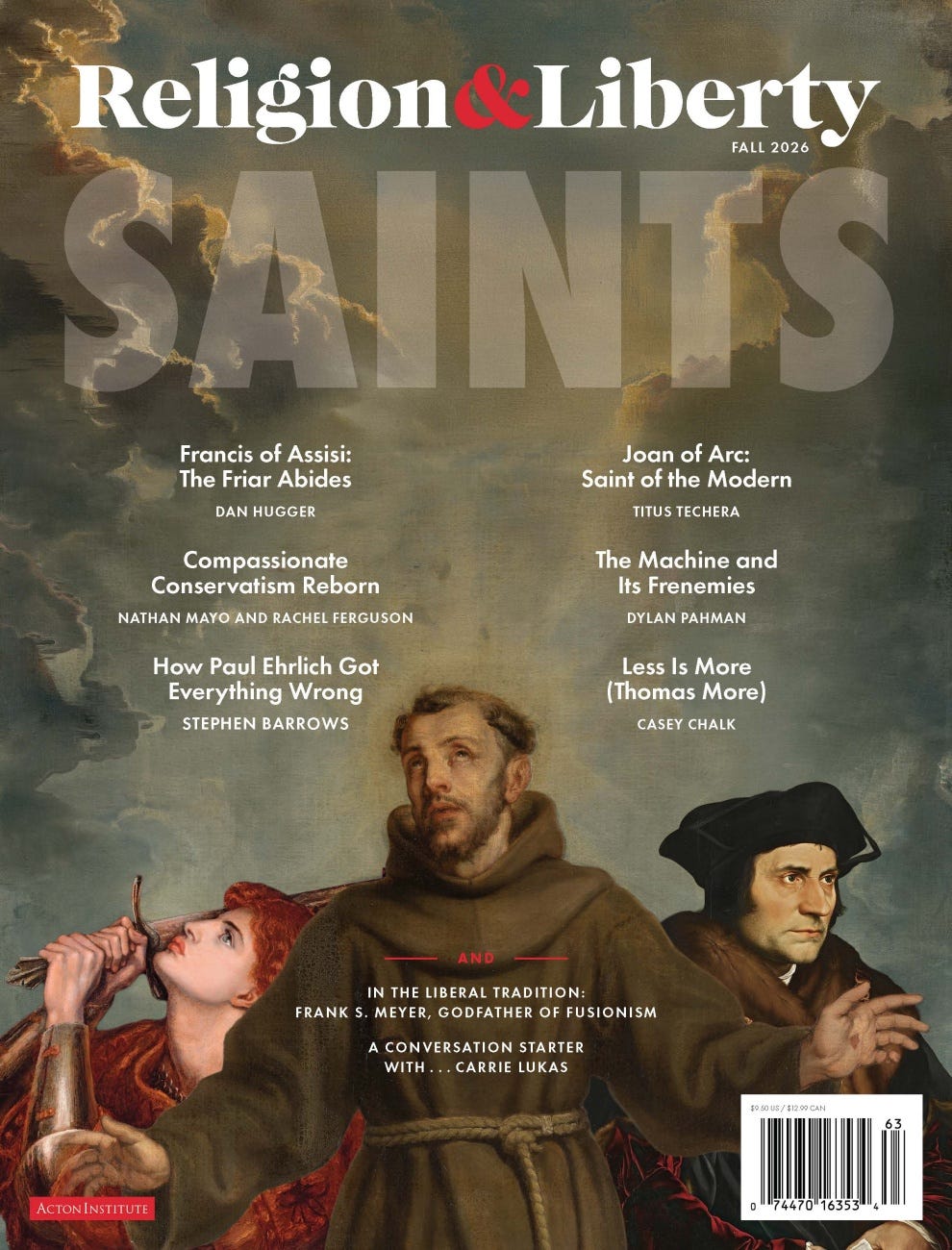
That gap between the Francis of history and the Francis of imagination is the subject of my new essay, “St. Francis of Assisi: The Friar Abides,” published yesterday in Religion & Liberty.
G.K. Chesterton identified what he called “the problem of St. Francis” in his 1923 biography of the saint: modern readers are drawn to the gentle friend of beggars and birds and then recoil from the hair shirt, the fasting, and the stigmata. His solution was to insist that saints are first of all lovers, and lovers have always looked a little mad to those outside the romance.
But I argue in the essay that Chesterton’s problem is a problem of St. Francis, not the problem. Eleven years before his book appeared, a small French Catholic magazine, La Clochette, printed an anonymous prayer for use at Mass. A Quaker periodical reprinted it in 1927 under Francis’s name, and from there the misattribution ran. Cardinal Spellman distributed it by the millions to American servicemen during the Second World War, it became a fixture of church bulletins and twelve-step meetings, and the Hindu teacher Eknath Easwaran recommended it to his Berkeley students as the gateway to meditation. For a many today, Francis is mediated almost entirely through words he never wrote. Chesterton’s problem was a modern one. This one is postmodern, and it needs its own answer.
To begin answering it, I lean on Augustine Thompson’s Francis of Assisi: A New Biography (2012), the surest guide we have to separating the historical Francis from the pious legend. The young Francis Bernardone that emerges is recognizably the saint in seed: a cloth merchant’s son with enough Latin to keep the ledgers and enough French to sing the popular songs, vain about his clothes, lavish with his friends, and stung with remorse the one time he brushed off a beggar at the shop door. Then war, capture, and a long imprisonment that left him with nightmares and no joy in the natural world that once delighted him.
Most striking in Thompson’s account is the prayer Francis finally poured out before the crucifix at San Damiano. He did not ask for his health back, or his friends, or peace with his bewildered and loving parents. He asked for light in the darkness of his heart, for faith, hope, and charity, and for the knowledge to carry out God’s command. It is a terrifying prayer, because such prayers tend to be answered. Everything that followed—the lepers, the orders he founded with Clare, the sermon before the Sultan, the wounds he hid for the last two years of his life—flows out of that prayer asked and answered.
The historian can tell us that the stigmata were real; a score of Assisi citizens signed a document attesting to them. The historian cannot tell us what caused them. And this is the point at which I part company, gently and respectfully, with the historian’s authority altogether. Thompson laments that “everyone has his or her own Francis.” That is true, but not only because legend has crowded out fact. It is true because Francis is alive in the presence of a God who is, as Christ reminded the Sadducees, God of the living and not of the dead. The saints have earthly lives, but their life is not merely earthly.
So the test of a genuine encounter with Francis is not whether it passes muster in the archives but whether it bears fruit: whether it enlightens the heart and enlarges charity, on Wall Street or Main Street or in the kitchen. A bird bath in a suburban garden can pass that test. So, for that matter, can a prayer Francis never wrote.
Still, it is worth knowing which words are his. Francis composed the Canticle when he could barely see the sun he was praising. The anonymous author of La Clochette composed a prayer that has carried his name into millions of lives. One is history and one is reception, and both are instruments. The friar abides in each.
You can read the full essay here.