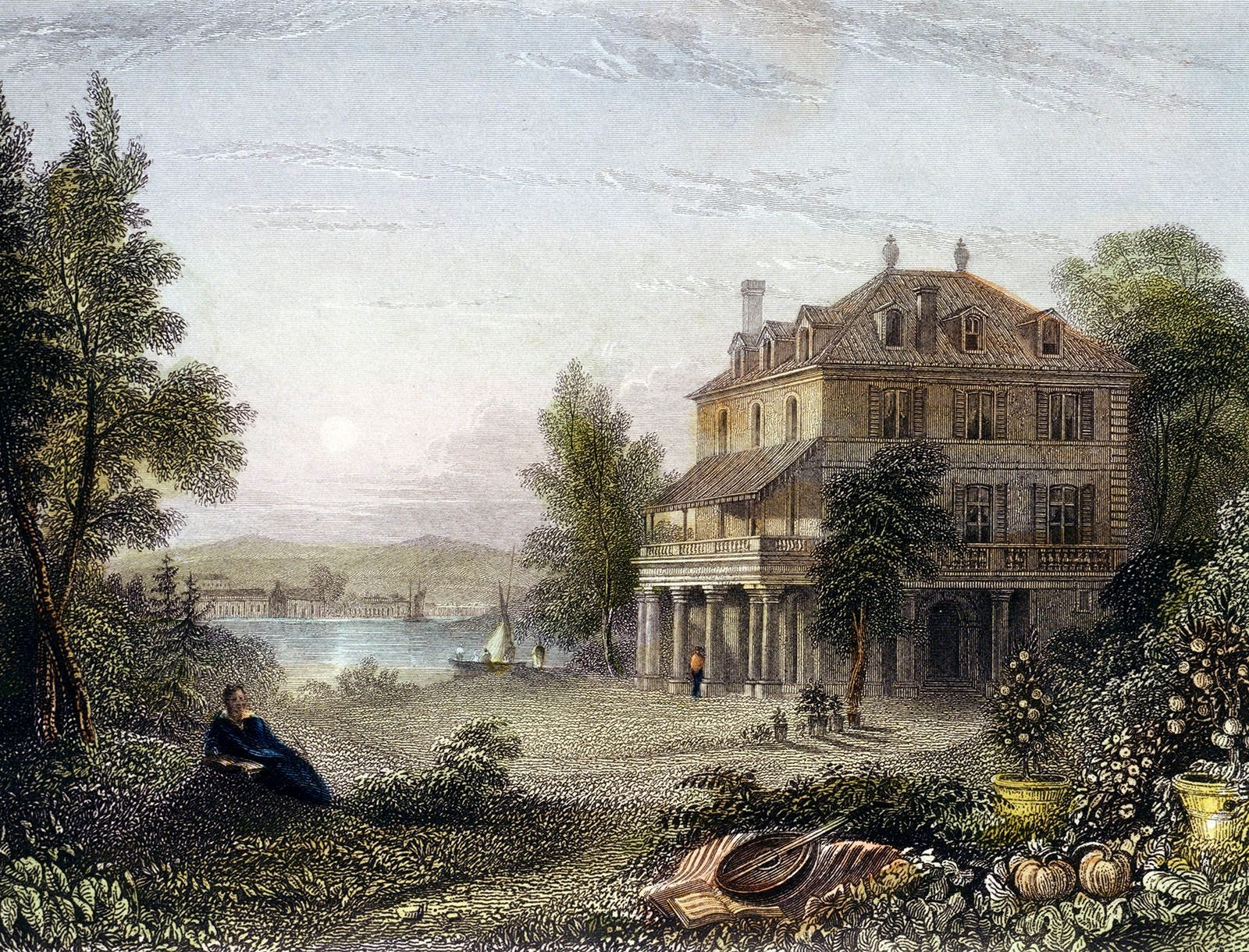
In June of 1816, the “year without a summer,” when volcanic ash from Mount Tambora darkened skies across Europe, a small party of English travelers found themselves trapped indoors at the Villa Diodati on Lake Geneva. To pass the gloomy evenings, Lord Byron proposed a contest: each would write a ghost story. Most of the entries came to little. But an eighteen-year-old named Mary Godwin, soon to be Mary Shelley, conceived there the tale that became Frankenstein, and with it, science fiction itself.
No publisher commissioned it. No industry planned it. The genre that now fills multiplexes and bestseller lists was born at a house party, among friends reading their work aloud to one another.
I thought of that villa earlier this month in a less romantic setting: the DoubleTree by Hilton near the Grand Rapids airport, where I attended BasedCon 2026, a science fiction and fantasy convention. My reflections on the weekend are now up at Religion & Liberty Daily: “Portrait of the Artist as Based.”
The essay opens with the word itself. A “con” is a swindle; a “con” is also a convention; and “based”, a coinage of the rapper Lil B, later adopted by the online right, promises authenticity, being yourself without fear of what others think. BasedCon advertises “a community that feels serious without being stiff.” Whether that promise would prove a work of con artistry in the honest or the dishonest sense was the question I carried through the hotel doors.
The right-coded signaling was there, as the name suggests. But the foreground of the con was based in the broadest and best sense: authors reading works in progress with real vulnerability, panels on the Chosen One trope and the Dark Lord problem conducted with amiable disagreement, and a formal debate between a medievalist and a scientist on whether good storytelling requires fidelity to genre conventions. I left with two books purchased on the strength of brief readings alone.
The most bracing session tackled the elephant in the publishing room: there are too many books chasing too few readers. What struck me was how little despair attended this fact. When Amazon searches yield a pile of slush, an arbitrage opportunity arises. Small, dense networks where readers actually know authors look less like a dying industry and more like an artistic scene. Success, on this view, is defined neither by fame nor fortune but by finding a dedicated audience, even one of three hundred readers.
And the writers doing this work are systems engineers and church music directors. This is not a scandal but a tradition, one the essay traces through some illustrious company. The choice facing a writer has never really been between writing full-time and not writing at all, but between what I call consumptive and creative leisure, between making something and scrolling.
I went to BasedCon expecting to observe a subculture. I came away having received, in a mysterious way, a summons to boldness in my own work, one I try to articulate in the essay’s closing turn, which I won’t spoil here.
The party at the Villa Diodati had no idea they were founding anything. They were amateurs in the oldest sense, lovers of the work, reading aloud to a room of friends on a dark summer evening. Two centuries later, the skies over publishing look dark again: the flooded market, the vanishing midlist, the pile of slush. But science fiction has been here before. It was born in exactly this weather, at exactly this scale: a few writers, a few readers, and a story worth telling. There are only too many books if books exist solely to be sold and not crafted. The villa by the lake, the DoubleTree by the airport: the light gets made indoors.
Read the whole thing at Religion & Liberty Daily.