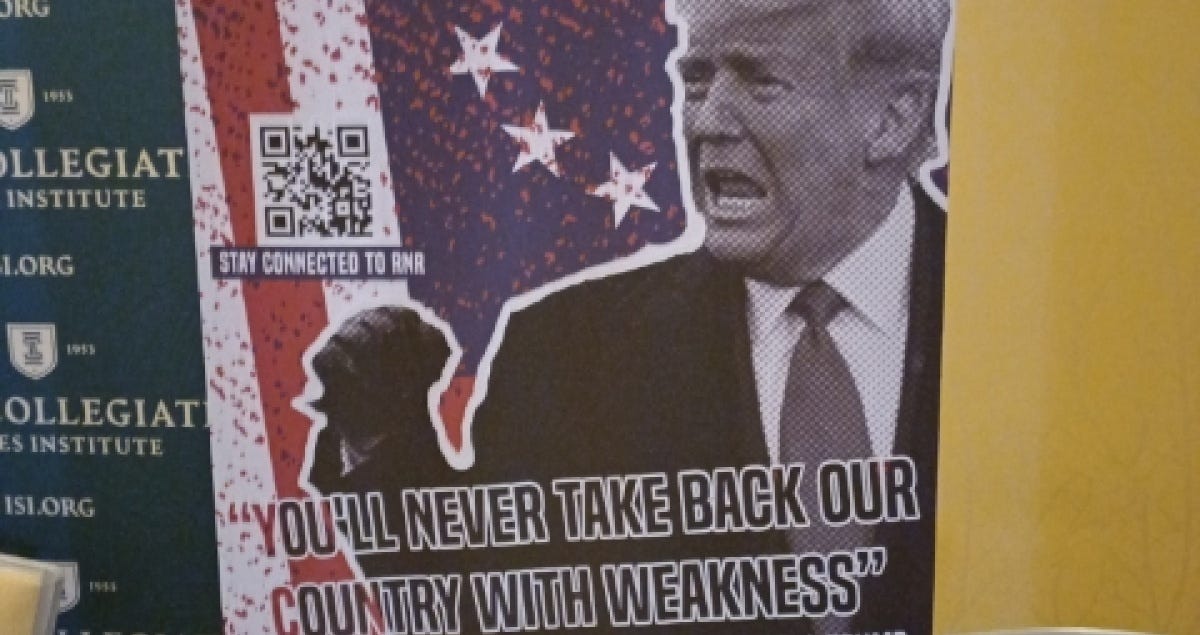
In the fall of 2021, I attended NatCon 2 at the Orlando Hilton. I was there on assignment for the Acton Institute, and I didn’t quite know what I was walking into.
What came out of that experience was “What I Saw at the National Conservatism Conference,” published in the Winter/Spring 2022 issue of Religion & Liberty. It was my first major feature essay, and it became the beginning of something I didn’t anticipate: a years-long project of chronicling the development of the National Conservatism movement from the inside.
I’ve since written multiple essays tracing the movement’s evolution from an amorphous outsider insurgency to a force that now claims to simply be the conservative movement. Looking back, one of the things that strikes me most about that first NatCon experience is just how different the movement’s relationship with Donald Trump was compared to today.
At NatCon 2, the conference was circumspect about Trump. His image appeared on a vendor table banner alongside Ron DeSantis, but on the stage and in the intellectual life of the conference, the movement was trying to be something distinct. The NatCons billed themselves as “against the dead consensus”, the old fusionism of Buckley and Reagan, and were positioning themselves as a movement of ideas, not a personality cult. Yoram Hazony, the movement’s intellectual architect, even floated the possibility of alliances with “anti-Marxist liberals.” Many of the speakers, I noticed, sounded in substance like the very fusionists they claimed to have superseded.
The conference room was often half-empty. Most of the attendees I met were students or think tank staffers. There was an earnestness to it, a sense of a movement still figuring itself out, still undertheorized and untested as a political coalition. Trump was in the air, but not quite in the room.
Compare that to what came after.
By NatCon 3 in 2022, Florida Governor Ron DeSantis was a keynote speaker, and Kevin Roberts, president of the Heritage Foundation, claimed the movement as “ours.” The outsiders had become insiders. By NatCon 4 in Washington, D.C., the tone had shifted from triumphant to domineering. The FreedomConservatism statement of principles, an attempt to reassert the old fusionist synthesis, was dismissed from the podium as “totally insipid and anodyne.” Rachel Bovard captured the new mood when she declared that National Conservatism simply “is the conservative movement.”
And then there’s J.D. Vance, who has been the closing speaker at two NatCon conferences and is now Vice President of the United States. The circumspection about Trump that I observed in Orlando? It has been replaced by something closer to full alignment.
I didn’t set out to become a chronicler of this movement. I went to a conference, tried to make sense of what I saw, and wrote it up with some humor and, I hope, some honesty. But the story kept developing, and I kept writing. The journey from that half-empty conference room beside the open fire pit at the Orlando Hilton to the corridors of American power is one of the more remarkable trajectories in recent political history.
If you want to see where it all started, you can read the original essay here:
“What I Saw at the National Conservatism Conference” — Religion & Liberty, Winter/Spring 2022